Focus on interest-driven, independent practice, process participation, practicability, integration with faculty research projects, integration with discipline competitions and graduation design (thesis).
2. Project type and quantity:
The innovation training programs are divided into two categories: engineering hardware (including the combination of hardware and software), software and other categories.
Entrepreneurship training programs are divided into two categories: entrepreneurship training programs and entrepreneurship practice programs.
In the entrepreneurship training program, the student team, under the guidance of the tutor, divides the roles of team members, completes the preparation of business plans, carries out feasibility studies, simulates the operation of enterprises, participates in enterprise practice, writes entrepreneurship reports and other work;In the entrepreneurship practice program, the student team, under the joint guidance of the school tutor and the enterprise tutor, adopts the results of the early innovation training program (or innovative experiment), puts forward an innovative product or service with market prospects, and carries out entrepreneurial practice activities on this basis.
It is planned to select around 900 projects for the Innovation and Entrepreneurship Training Program in 2026. Among them, 20 Innovation Training Programs with special topics forStudent-Driven Pedagogical Enhancementwill be selected, with the principle that each college can only submit one project.
In 2026, we plan to select 30 corporate-driven innovation training programs, including 15 at the national level and 15 at the provincial level, with each project receiving 5,000 yuan in corporate funding.
3.Requirement for topic selection:
Innovation and entrepreneurship training programs are not limited to disciplines, and the selected topics should have certain academic value, theoretical significance or practical significance. Have innovative or obvious entrepreneurial education effect; The topic selection direction is correct, the content is substantial, the demonstration is sufficient, the difficulty is moderate, the key and difficult points to be broken through are clear, the research ideas are clear, the research methods are scientific, the research program is feasible, and the expected results are verifiable.
Students can choose their own topics within a certain range according to their interests. The scope of topics is as follows: sub-projects related to teachers' research and technology development (service); Comprehensive, designed and innovative experimental projects in open laboratories, training or practice bases; Invention, creation, design and other production projects; Specific projects or open topics set by enterprises that are decomposed and refined by the latest industrial needs and actual production problems of enterprises; Business incubation projects for college students in and outside the campus; All projects that combine scientific and technological innovation to be practiced in entrepreneurship;
Professional research and innovation projects, entrepreneurship and career planning innovation projects; Social survey project; Other projects with research and practical value. To encourage the national economic and social development, have a certain theoretical and practical significance of the topic, encourage directly from the industry line, science and technology frontier topics; It encourages the development of certain innovative basic theoretical research and targeted applied research topics, and encourages the research of emerging marginal disciplines and cross-disciplinary comprehensive research topics. Focus on supporting innovation and entrepreneurship training projects with prospects of technology, commercialization and industrialization.
The topic selection range for the innovation training program projects for Student-Driven Pedagogical Enhancement is provided in Attachment 3. Students can autonomously choose their topics within this range based on their interests.
The Corporate-driven innovation training programs must select topics in accordance with corporate requirements; please refer to Attachment 4 for details on these requirements.
4.Object of declaration:
The applicants for the innovative training program are undergraduates of the class of 2024, and the number of students in each project is generally 3-5. Applicants for entrepreneurial training programs or entrepreneurial practice programs are undergraduate students, and the person in charge is in principle a 2023 or 2024 undergraduate student, and the number of each team is generally 3 to 5 people.
Project team members must have a clear division of work. The training program is not limited to disciplines, and interdisciplinary and cross-professional cooperation is encouraged to apply for projects. Each student can only participate in one innovation and entrepreneurship training project in this batch, and is not allowed to cross-declare between different projects at the same time. Students who have participated in innovation training programs in previous years can apply for entrepreneurship training programs this time.
5.Declaration procedure and time:
Projectapplication website: https://cxcyjy.njupt.edu.cn/pt
Specific arrangements are as follows:
Time | work content |
Week 5 | The university issued a notice of application for college students' innovation and entrepreneurship training program |
Weeks 6-7 (April 6 - April 17) | The College organized students to fill in the project application form online and instructed teachers to review it online. For the Corporate-Driven Innovation Training Program, please submit the electronic version of the project proposal form through your respective college to the School of Innovation and Entrepreneurship Education at cxcy@njupt.edu.cn by April 10. The review results will be announced by April 17. Projects that are not selected may still be submitted through your college. |
Week 8 (April 20 - April 24) | The College organized an expert group to review and recommend university-level and above projects, and submitted a summary of the recommendation level and ranking order |
Week 9 (April 27 - April 30) | The university held an expert review meeting and announce the project and carry out the project launch publicity |
6.The student application procedure is:
Students should fill in the Application Form for Innovation Training Program Project of Nanjing University of Posts and Telecommunications (see Attachment 1) or the Application Form for Entrepreneurship Training Program Project of Nanjing University of Posts and Telecommunications (see Attachment 2) and apply online;Guide teachers to review online, and organize experts to review online and report the results;The school will organize experts to review and publicize and issue the notice of project approval results.
Attachment:
1. Application for college students' Innovation Training Program of Nanjing University of Posts and Telecommunications table
2. Application form for Student Entrepreneurship Training Program of Nanjing University of Posts and Telecommunications
 附件二:南京邮电大学大学生创业训练计划项目立项申请表.doc
3.Special Topics for Student-Driven Pedagogical Enhancement
4.Requirements for the Corporate-Driven Innovation Training Program
 附件四:2026年南京邮电大学大学生创新训练项目企业命题汇总表.xlsx
College students innovation and entrepreneurship training plan management system
System login:
Method 1 :
System address: https://cxcyjy.njupt.edu.cn/pt

Select统一认证登录(unified authentication login), and enter your Smart Campus account and password.
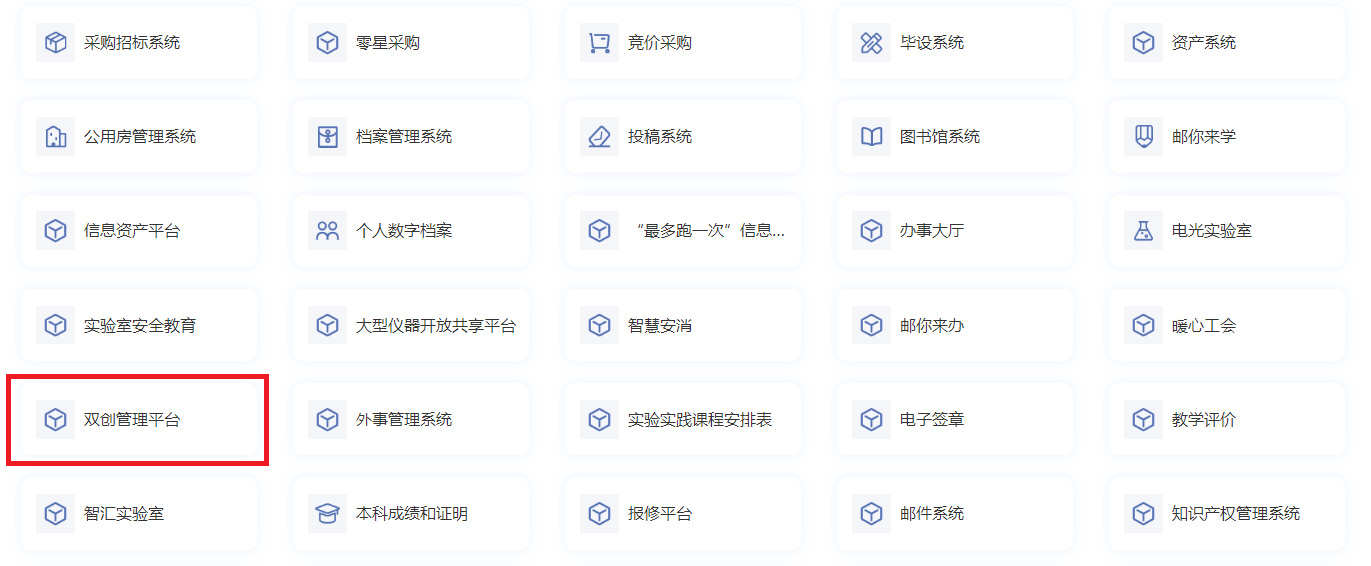
Method 2 : Smart Campus -双创管理平台(Innovation and Entrepreneurship Management Platform)-大学生创新创业训练计划管理系统STITP